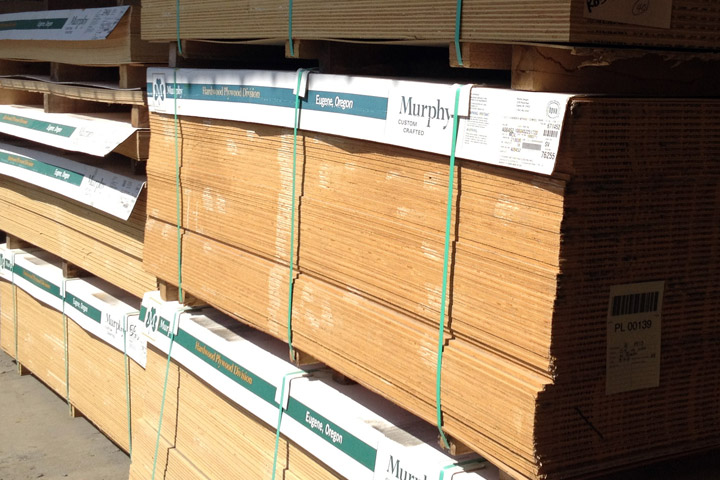
Veneer core plywood is great for a variety of different applications, but it’s not the only option. There are times when you’ll want to consider plywood varieties that are manufactured using either lumber core, MDF core, or particle board core construction. In our final article (previous articles: 1, 2 & 3), we’ll give a brief overview of these types of plywood so you can make a more informed choice for your next plywood project.
Lumber Core Plywood
When manufacturers make lumber core plywood, it is normally made from Basswood or a similar hardwood. Compared to veneer core plywood, the strips of wood that are used for the construction of lumber core plywood are relatively thick. After the thick strips of hardwood are glued together to make a large panel, a veneer facing is placed over the panel. Lumber core plywood is an ideal choice for applications that involve routed edge treatment where edges will remain exposed.
One of the drawbacks to this type of plywood core is that it is the most expensive to manufacture. The high cost of construction makes it a less popular choice for manufacturers to make. This can lead to a lack of supply sources. High grade, quality lumber core can be extremely difficult to find, but low-grade lumber core isn’t worth considering for most projects. That’s because the low-grade lumber core plywood is often riddled with problems, such as large gaps and a high level of inconsistency. Depending on your location you may have trouble even being able to locate an affordable, reputable source for lumber core plywood.

Composite Substance Plywood Options: Particle Board Core and MDF
First, let’s consider what the two types of plywood cores have in common. They are both made from wood particles that are fastened together using glue to make stable substrates. Onto these flat sheets of plywood both cores receive a veneer face application. Both core varieties are quite a bit heavier than plywood cores that are made using solid wood. They both tend to be extremely stable. In the past, purchasers of Particle Board Core and MDF sometimes complained that they had inferior screw holding capability. Now, thanks to innovations in screw designs, these boards are great at holdings screws. Just be sure that if you use them you purchase screws specifically made for these types of plywood cores. These screws are designed with wider than normal threads.

Now, let’s look at some of the differences between Particle Board Core and MDF. Even though both Particle Board Core Plywood and MDF Plywood are composites, they are constructed with different sizes of particles. This key difference between the two can make a big impact on performance. Particle board cores are made with larger wood pieces than those used in the construction of MDF cores. That means that Particle boards are lighter than MDF. On the downside, Particle board is more prone to splintering and isn’t quite as durable as MDF core plywood boards.
Since MDF is constructed from extremely fine particles, it will tend to be very stable and extremely heavy. The edges are strong and its underlying layers are ideal for being milled for a variety of different uses.
As you can see, there are a whole host of choices available when it comes to plywood cores. If you still aren’t sure which one would be best for your intended application, continue to educate yourself about the way the available cores react under different circumstances. The more you understand about plywood core behavior, the better equipped you will be to make a wise decision when selecting a product for your upcoming project.